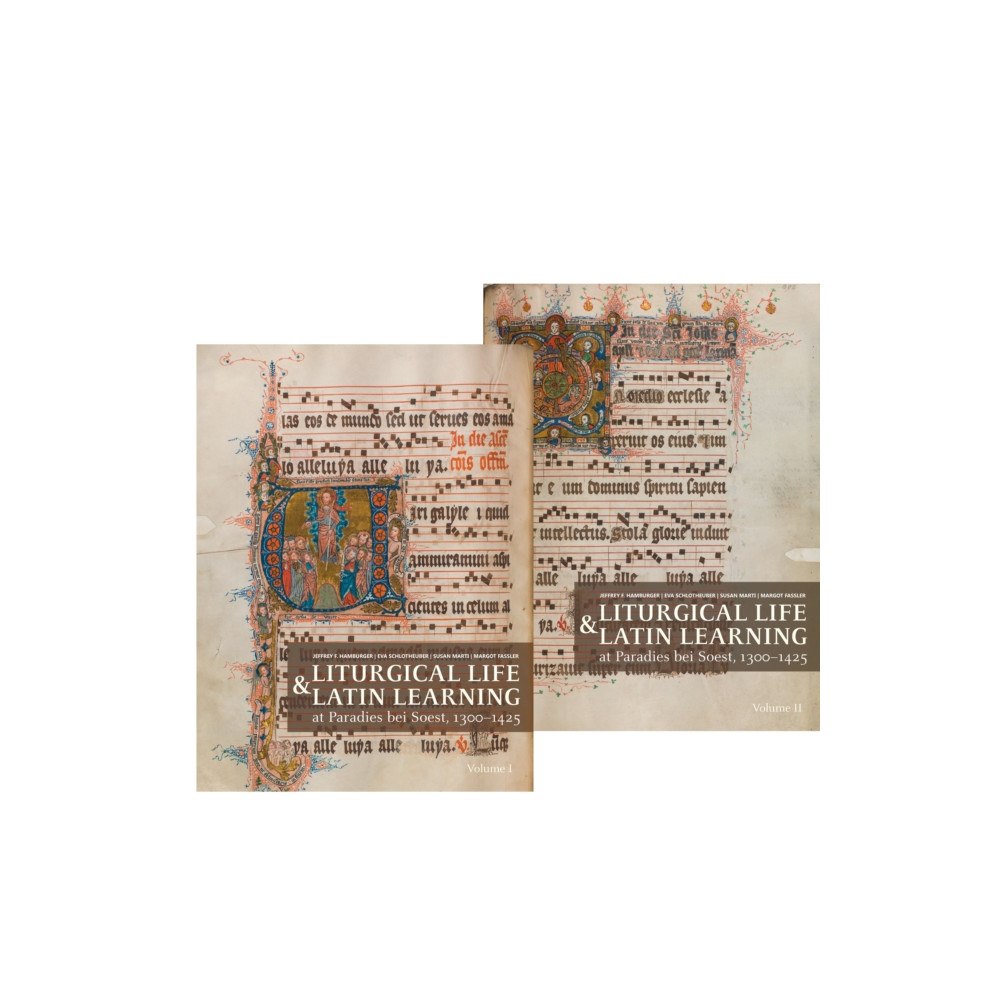
Written by an international team consisting of two art historians, an historian and a musicologist, this study explores the intellectual, scribal, artistic and musical culture of the Dominican nuns of Paradies from a variety of perspectives. Taking as its subject a little-known group of fourteenth- and early fifteenth-century liturgical manuscripts from the Dominican convent of Paradies bei Soest (Westphalia), the book also offers a revisionary account of the development of the Dominican order in late medieval Germany.
_x000D_ Two antiphonaries, three graduals and additional fragments made both for and by the nuns testify to a self-conscious liturgical culture closely tied to the development of the Dominican order’s female branch. One manuscript in particular, a gradual written and illuminated at Paradies ca.
1380 (Düsseldorf, ULB D 11) contains an unparalleled wealth of inscribed images which make it the most extensively illuminated liturgical manuscript of the entire Middle Ages. The learned inscriptions allow for not only a reconstruction of the nuns’ library, but also a thoroughgoing re-evaluation of the learning and Latin literacy of mendicant nuns in the late fourteenth century, a period that in the accounts of modern scholars as well as medieval reformers has too quickly been discounted as a time of intellectual and institutional decline.
_x000D_ In text, image and chant, the nuns assembled a comprehensive commentary on the liturgy, one which serves as a testament to their creativity, learning and ambition as well as their devotion.
| Format |
Inbunden |
| Omfång |
1440 sidor |
| Språk |
Engelska |
| Förlag |
Aschendorff Verlag GmbH & Co. KG |
| Utgivningsdatum |
2016-11-15 |
| ISBN |
9783402130728 |